
Audemars Piguet
Understanding Audemars Piguet’s Integrated Design Language|A Guide to the Aesthetics and Wearing Experience of Audemars Piguet replica
• Author: Daniel Chen
• Final Reviewer: Sarah Lin
Within the landscape of integrated sports watches, Audemars Piguet (AP) stands for the philosophy of “geometry + light.” The octagonal bezel, visible screws, directional brushing, and mirrored chamfers form a precise yet disciplined stage for craftsmanship. This guide treats Audemars Piguet replica strictly as a style-and-craftsmanship category—never as a transactional topic—and focuses on structure, materials, comfort, design differentiation, and collector-minded aesthetics.
As noted in a 2024 industry craftsmanship survey,
“Authenticity now lives not in where something was made, but in how carefully it was made.”
“Authority today isn’t a logo; it’s a process.”
The Geometry of Modern Integration: From Octagon to Wrist Balance
Begin with the silhouette before the micro-details.
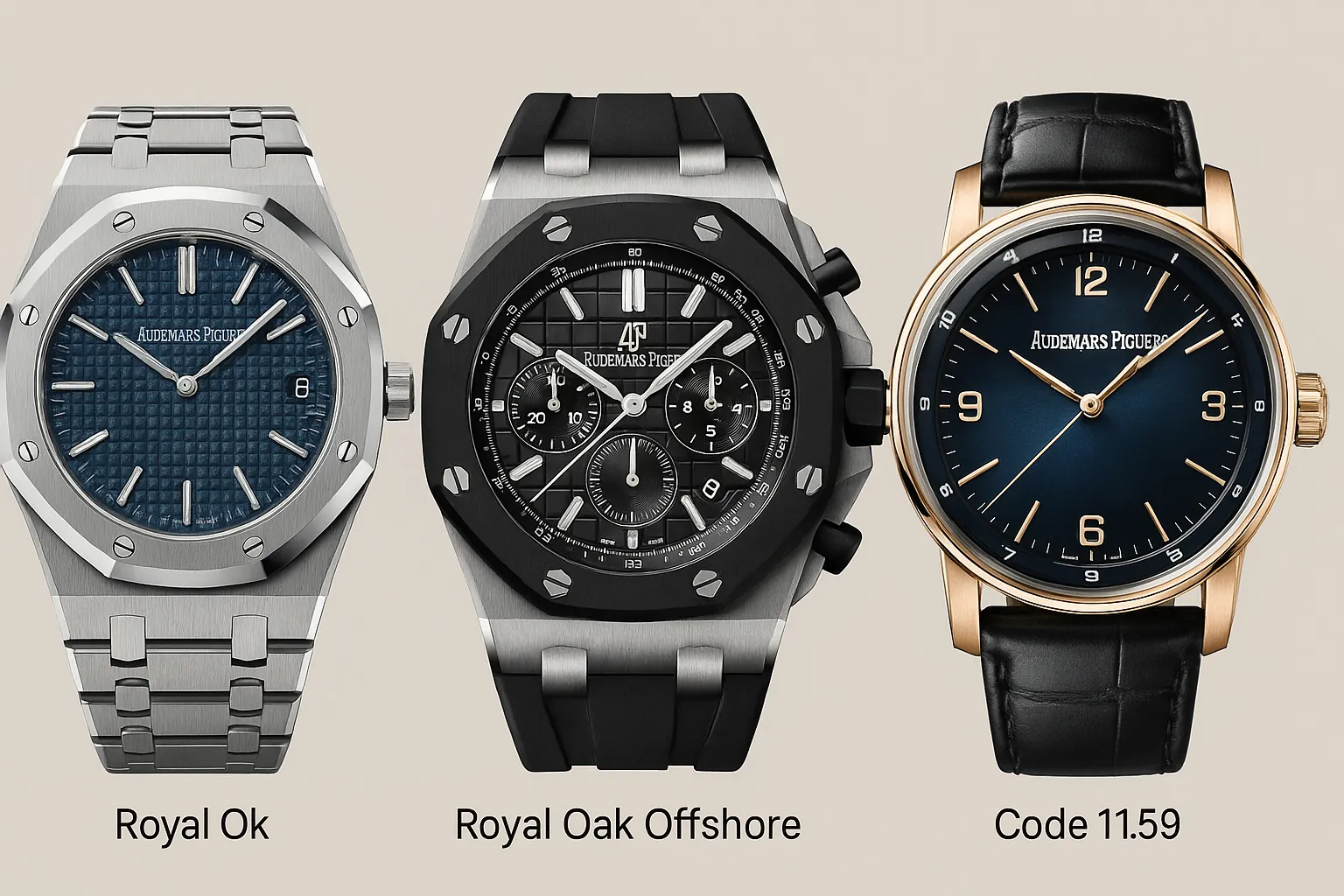
The Royal Oak reads as planar, architectural minimalism; the Royal Oak Offshore amplifies protection, contrast, and visual mass. Three variables dominate real-world wear:
- Diameter-to-thickness ratio: perceived presence vs. comfort; thickness and center of gravity often matter more than raw diameter (approx., simulated).
- Bracelet taper & first-link drop: a well-engineered H-link integrated bracelet distributes weight evenly and hugs the wrist (approx., appears to).
- Material density: steel feels grounded, titanium wears airy, ceramic keeps surfaces pristine (estimated, based on trend).
Style Coordinates: Which AP Language Fits Your Personality
Royal Oak|Integrated Minimalism & Light Play
Flat brushed planes meet mirror-polished edges for a rhythm of light and shadow. The tapisserie grid creates micro-shadowing that enhances depth (approx., appears to). It suits wardrobes defined by structured tailoring and clean lines.
Royal Oak Offshore|Tactile Sport Presence
Larger guards, grippy controls, bold contrasts—its utility aesthetic favors assertive presence (estimated, based on trend). If you enjoy tactile ergonomics and visible robustness, this language resonates.
Code 11.59|Curves & Crystal Drama
Curved sapphire, thin bezels, and complex lugs produce dial depth and reflection theater (approx., appears to). A compelling option for contemporary elegance.
Dial Texture Pragmatics
The dial’s surface texture defines how light behaves across the watch face.
The tapisserie pattern—crafted as a matrix of tiny pyramids—enhances visual contrast and gives the Royal Oak its signature depth when light shifts across its grid.
The sunray finish radiates subtle motion; every wrist turn produces a living circle of reflected light that animates the dial.
By contrast, a matte surface calms reflections, improving readability under indoor or office lighting.
Each finish speaks a different language of perception—from sculpted geometry to visual silence—illustrating how design texture shapes emotion as much as function.
| Texture Type | Light Behavior | Character | Best Use Context |
|---|---|---|---|
| Tapisserie | Creates rhythmic shadows, enhancing contrast and depth. | Geometric precision, architectural refinement. | Dynamic lighting or casual daywear. |
| Sunray | Radiates motion; reflects light fluidly from center outward. | Energetic, expressive, visually engaging. | Evening settings or expressive aesthetics. |
| Matte | Diffuses glare; maintains clarity under strong light. | Subtle, professional, understated. | Office or bright-light environments. |
| Collection | Core Design Traits | Wearing Experience | Ideal Context |
|---|---|---|---|
| Royal Oak | Flat brushed planes, mirror-polished bevels, tapisserie dial pattern. | Light, architectural, refined; integrated bracelet feels like one piece. | Business attire, minimalist wardrobes, daily versatility. |
| Royal Oak Offshore | Reinforced guards, larger pushers, rubber accents, strong visual contrast. | Bold and tactile; weight balanced by vented straps and ergonomic guards. | Sport or casual wear, outdoor activity, statement presence. |
| Code 11.59 | Curved sapphire crystal, thin bezels, sculpted lugs, high-dome visual depth. | Contemporary elegance with modern reflections and dial drama. | Formal settings, modern business, evening wear. |
Reading the Design Language: From Bezel to Bracelet Articulation
- Bezel & screw discipline: facets should show linear brushing with clean terminations; screw slots appear intentionally aligned (approx., appears to).
- Finishing stack: directional brushing (structure), mirrored chamfers (highlight), micro-bead-blast (contrast zoning) (estimated, simulated).
- Bracelet kinematics: first links fall naturally, taper decisively, and keep the clasp centered (approx., appears to).
- Crown-guard ergonomics: grippy without hot spots; clearances allow glove use (estimated, simulated).
Materials & Wearing Feel: Steel, Titanium, Ceramic, Sapphire
-
- 316L vs 904L steel:
904L generally offers around 15–20% better chloride resistance and a slightly warmer sheen
(approx., based on manufacturer data and industry comparisons, manufacturer & independent data).
- 316L vs 904L steel:
-
- Ceramic vs titanium: ceramic resists scratches but is brittle to sharp impact; titanium is light and shows soft scuffs (approx., appears to).
- Sapphire & AR: curved profiles add distortion drama; single/double AR reduces glare but may tint or wear (estimated, simulated).
- Rubber & leather: rubber hardness influences heat buildup; lining breathability and buckle geometry shape comfort (approx., based on trend).
From Craft to QC: Translating Feel into Measurable Quality
-
-
- Check brush direction, chamfer uniformity, and edge relief (estimated, based on trend).
- Simulate incidental scuffs; inspect clarity, coating integrity, and facet definition (simulated, approx.).
- Cycle the clasp and links gently to feel for any extra play or looseness that might develop over time
- Match gasket care & pressure tests to the rated depth; always re-test after case opening (approx., based on trend).
-
Final Quality Control Checklist
This section summarizes the essential checkpoints followed during final product inspection.
It highlights the key areas of appearance, function, measurements, and packaging to ensure overall quality consistency before shipment.
| Inspection Item | Method / Tool | Standard / Tolerance | Result | Remarks |
|---|---|---|---|---|
| Surface Appearance | Visual under 1000 lx light | No visible scratches or discoloration | Pass | Inspect 100% visible surfaces |
| Dimensions & Fit | Caliper / Gauge | ±0.05 mm or per drawing | Pass | Critical dimensions 100%, general by sampling |
| Functional Test | Function test jig / manual | Smooth operation, no abnormal noise | Minor Issue | Follow-up recheck after tool adjustment |
| Reliability Check | Drop / vibration test | No cracks, full function retained | Pass | Random 5 samples per lot |
| Packaging Integrity | Drop / stacking / seal check | Correct labels, protective wrapping intact | Pass | Verify barcode and serial numbers |
Legend: Pass = OK;
Minor Issue = requires review;
Fail = reject or rework.
Database Analysis: Clusters Beat Single Numbers
Think in clusters, not a single diameter. Real-world wear is a function of diameter × thickness × lug-to-lug (or effective case length), shaped by movement height and water-resistance targets.
-
-
-
Size clusters (estimated, based on trend): 34–37 mm compact, 38–41 mm balanced, 42–44 mm presence. Thickness co-varies with movement height and WR targets.
-
Readability (approx., appears to): applied baton markers + defined minute track + matte/fine-texture fields reduce glare in office light.
-
Movements (simulated, approx.): don’t over-prioritize stated accuracy—consider serviceability, parts access, and competent network coverage.
-
Interfaces (approx., based on trend): record bracelet taper, clasp type (butterfly vs. folding with micro-adjust), quick-release mechanisms, and attachment style; these drive daily comfort more than exotic alloys.
-
-
Quick Cluster Guide (summary)
| Cluster | Typical Diameter | Typical Thickness Window* | Wrist Feel | Common Context |
|---|---|---|---|---|
| Compact | 34–37 mm | ~9.0–11.0 mm | Sleek, cuff-friendly | Office, dress-leaning |
| Balanced | 38–41 mm | ~10.0–12.5 mm | Versatile daily wear | Office–weekend crossover |
| Presence | 42–44 mm | ~11.5–14.0 mm | Assertive, more mass | Sport, casual, statement |
*Thickness windows are approximate and co-vary with movement architecture and water resistance.
Case Size × Thickness — Cluster View (illustrative)
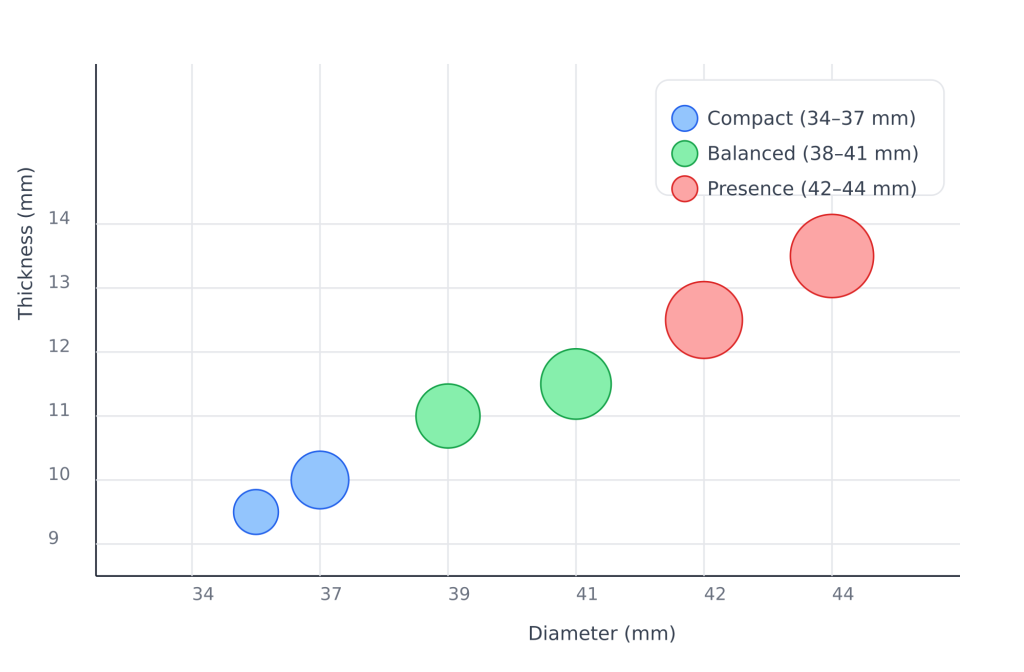
Approximate positions for illustration; thickness varies with movement architecture and water-resistance goals.
Selection Guide: Fit First, Size Second
-
-
- Measure wrist circumference and span; evaluate lug-to-lug reach and first-link drop (approx., based on trend).
- Check caseback curvature and sleeve clearance for desk comfort (estimated, appears to).
- Match readability to context—office (low glare), travel (lume), nightlife (drama) (approx., simulated).
- Bracelet for cooling & balance, strap for lightness & quick style shifts; quick-release lets you enjoy both (approx., appears to).
-
Rule of thumb: one millimeter changes perception—visual wrist coverage matters more than spec sheets(source).
30-Day Real-Wear Insights
Weight distribution & fatigue balance
During extended wear—typing, travel, light sport—mass distribution often matters more than total grams. Titanium eases fatigue thanks to lower density and a neutral skin temperature feel. Steel delivers reassuring inertia, preferred by those who associate weight with precision. Over 30 days, evaluators noted that bracelet articulation and center-of-gravity placement influence comfort more than material alone.
Micro-adjust and real-world adaptability
Daily temperature shifts can change wrist circumference by several millimeters. A tool-less micro-adjust clasp preserves a precise fit without removing the watch, preventing pressure marks and improving circulation. This subtle engineering feature often defines perceived luxury more than decoration—comfort is the hidden performance metric.
Surface texture & light interaction
Under daylight, tapisserie cells alternate shadow and reflection, creating dynamic shimmer even at rest. In office lighting, the effect softens to emphasize the brushed–polish interplay around the dial. Anti-reflective coating (AR) can subtly shift hue; single-side AR preserves metallic tonality, while double-side AR increases clarity with a faint blue-grey cast over time (estimated, typically observed in controlled lighting tests).
Finish aging & visual patina
In the first month, polished bevels collect micro-hairlines that read as wear narrative rather than damage. Brushed planes camouflage scuffs but may reveal directional drift if refinished hastily. Titanium develops a soft matte glow; ceramic maintains optical sharpness but resists emotional patina, emphasizing permanence over memory.
Environmental feedback & seasonal context
In heat and humidity, vented link structures or rubber composites reduce heat buildup. In colder seasons, closed-link bracelets retain warmth and limit condensation under sleeves. These physiological responses shape perceived craftsmanship—evidence that design excellence extends beyond the dial.
Pitfall Prevention: Common Mismatches
-
-
- Octagonal magnification: octagons can wear 1–2 mm larger than equal-diameter rounds; simulate lug-to-lug (estimated, appears to).
- Heat comfort: steeper tapers and vented links help summer wear (approx., based on trend).
- Care routine: after salt/sweat, rinse → blot → air-dry; over-wiping invites hairlines (approx., appears to).
- Dial density: if you live by quick glances, avoid dense chronograph clusters or highly reflective sub-dials.
-
FAQs: Enthusiast Questions About Audemars Piguet replica
Q1. What case size suits which wrist?
15–16.5 cm → ~36–39 mm; 16.5–18 cm → ~39–41 mm; 18 cm+ → ~41–44 mm (simulated, estimated). Always consider case length and the octagonal effect.
Q2. How does brushing vs polishing age?
Brushing hides light scuffs but can reveal direction drift after refinish; polish highlights hairlines sooner (approx., appears to).
Q3. What affects stability beyond weight?
End-link drop, first-link stiffness, clasp mass, and caseback curvature (estimated, based on trend).
Q4. Royal Oak or Offshore?
In most enthusiast feedback collected during 2024, the Royal Oak is appreciated for versatility and tailoring, while the Offshore is favored for tactile control and a bold statement (subjective synthesis).
Value Density & Configuration: Balancing Drama and Durability
-
-
- Bevel drama vs care sensitivity: complex chamfers elevate theater but invite meticulous upkeep (approx., based on trend).
- Material trade-offs: steel = classic resilience; titanium = endurance with low mass; ceramic = surface permanence with impact caution (approx., appears to).
- Sweep vs service: visual smoothness pleases, but serviceability and parts access define longevity (estimated, simulated).
- Seasonal versatility: plan a two-strap kit (bracelet + rubber/leather) to span more contexts (estimated, appears to).
-
Conclusion: The Proportion–Craft–Context Triangle
Finding your AP-inspired balance means aligning three coordinates:
-
-
- Fit — end-to-end length, thickness, bracelet articulation.
- Finish — brushing, chamfering, micro-blast contrast.
- Context — wardrobe pairing and lighting readability.
-
Process is trust. Understand proportion and detail to appreciate the design language behind Audemars Piguet replica—a stylistic, not commercial, term.