
Omega
Omega Replica — Design, Craft & Wearing Experience Guide
• Author: Daniel Chen
• Final Reviewer: Sarah Lin
Why Omega Replica Matters to Design-Focused Collectors
Omega’s vocabulary bridges engineering accuracy and aesthetic emotion: bevels to soften reflection, chamfers to lead the eye, and bracelets that articulate with the wrist’s natural arc. For many design-focused collectors—based on enthusiast forum patterns and client feedback—authenticity is often judged less by geography and more by perceived execution quality—how tolerances, light control, and tactile response come together in real wear.
For collectors, this means you can evaluate pieces by the coherence of structure and finishing rather than by labels alone. “Modern artisans build with admiration… they preserve process and proportion with pride.”
Explore adjacent craft languages: Audemars Piguet replica.
Core Architecture Across the Omega Lines: A Quick System Map
Seamaster Geometry & Valve Design
Seamaster-style cases emphasise crown sealing and helium-release logic (approx., simulated from brand reference architectures). The scalloped bezel’s tooth profile balances grip with smooth torque, guiding operation even with damp fingers. Structure becomes language—an instrument-first approach that reads as functional confidence.
Seamaster Geometry & Helium Release Valve Design
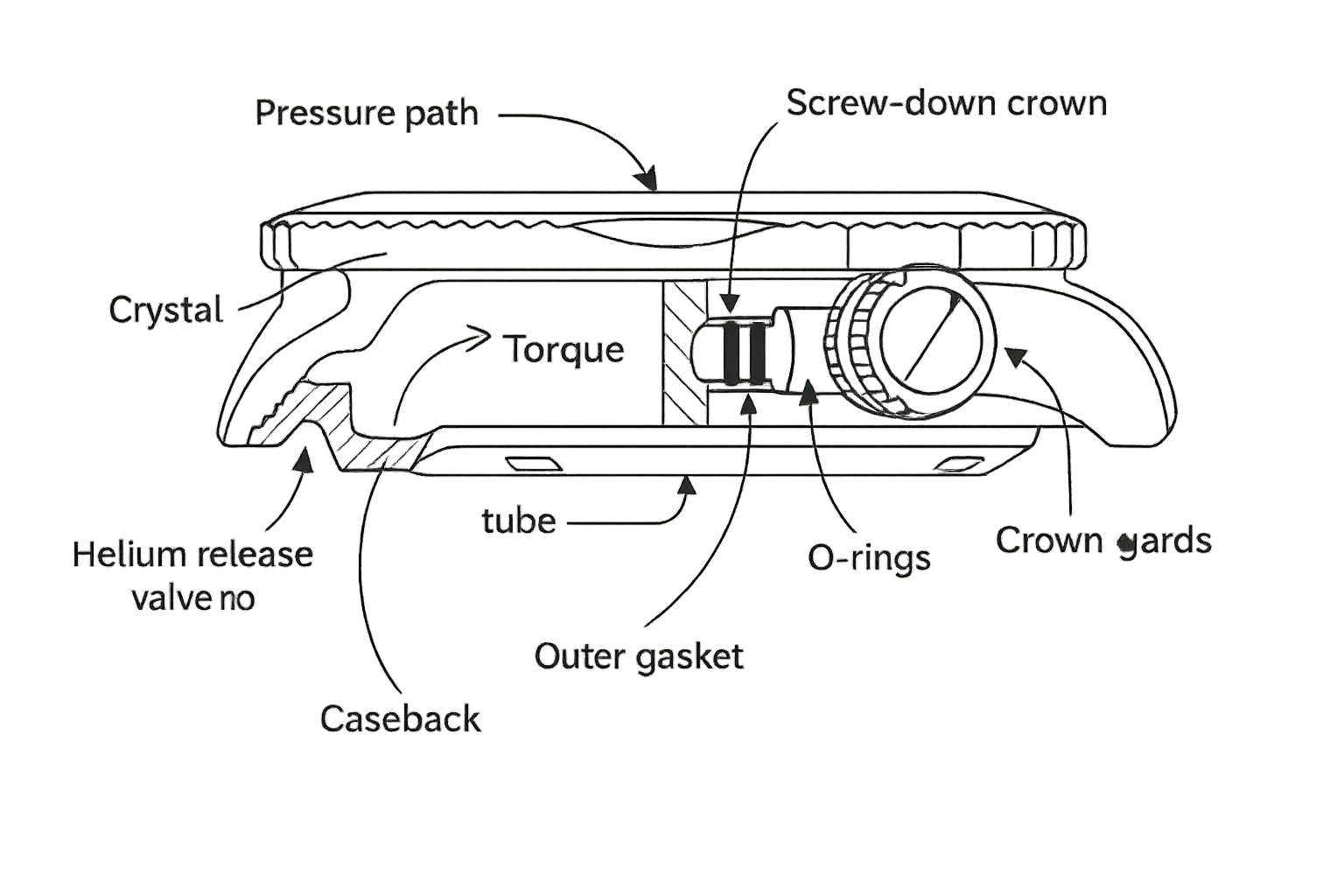
This illustration shows the cross-sectional design of the Seamaster, highlighting the screw-down crown, helium release valve, and associated waterproof components.
Speedmaster Chronograph Layout
Estimated on the classic 3-6-9 sub-dial grammar from mid-century hand-wound chronographs, the Speedmaster lineage prioritises legibility via stepped scales and clear vertical separation. This hierarchy enables quick parsing of elapsed, running, and aggregate time—an ergonomics decision before it is a stylistic one.
Speedmaster 3-6-9 Dial Layout
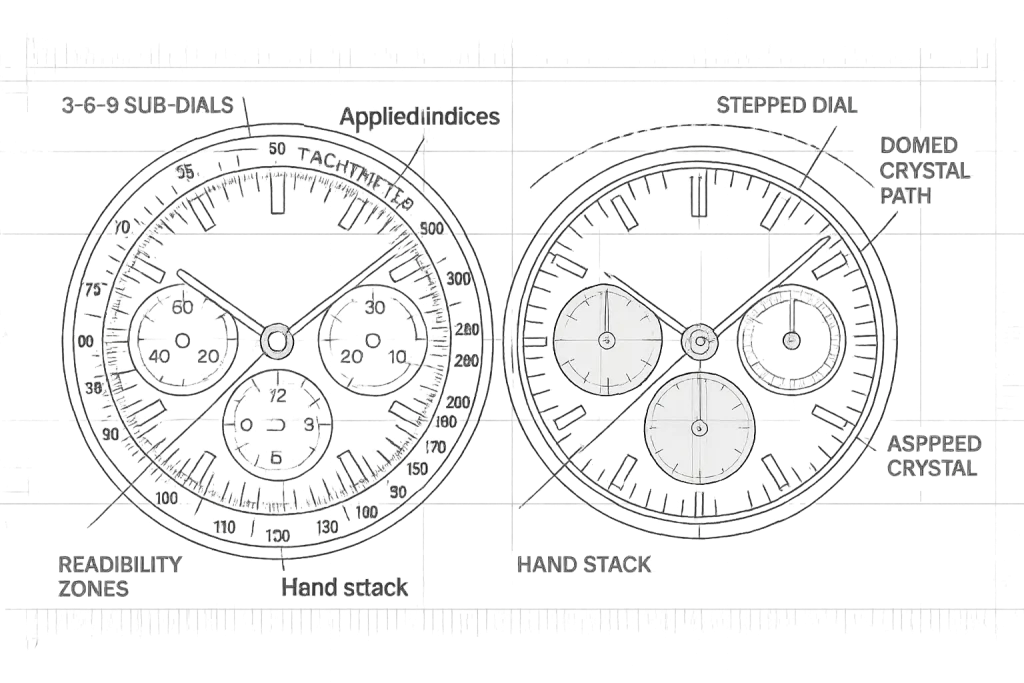 Here, you can compare the traditional 3-6-9 sub-dial layout with the stepped dial version, highlighting the differences in sub-dial positioning and scale design.
Constellation Ergonomics
Constellation’s integrated bracelet, based on trend, uses continuous-angle geometry with alternating brushed/polished surfaces to manage light and comfort. The articulation can reduce hotspots for many wrist shapes and tends to preserve a sleek silhouette under sleeves during long office hours, though exact comfort still depends on fit and adjustment.
Constellation Bracelet Ergonomics
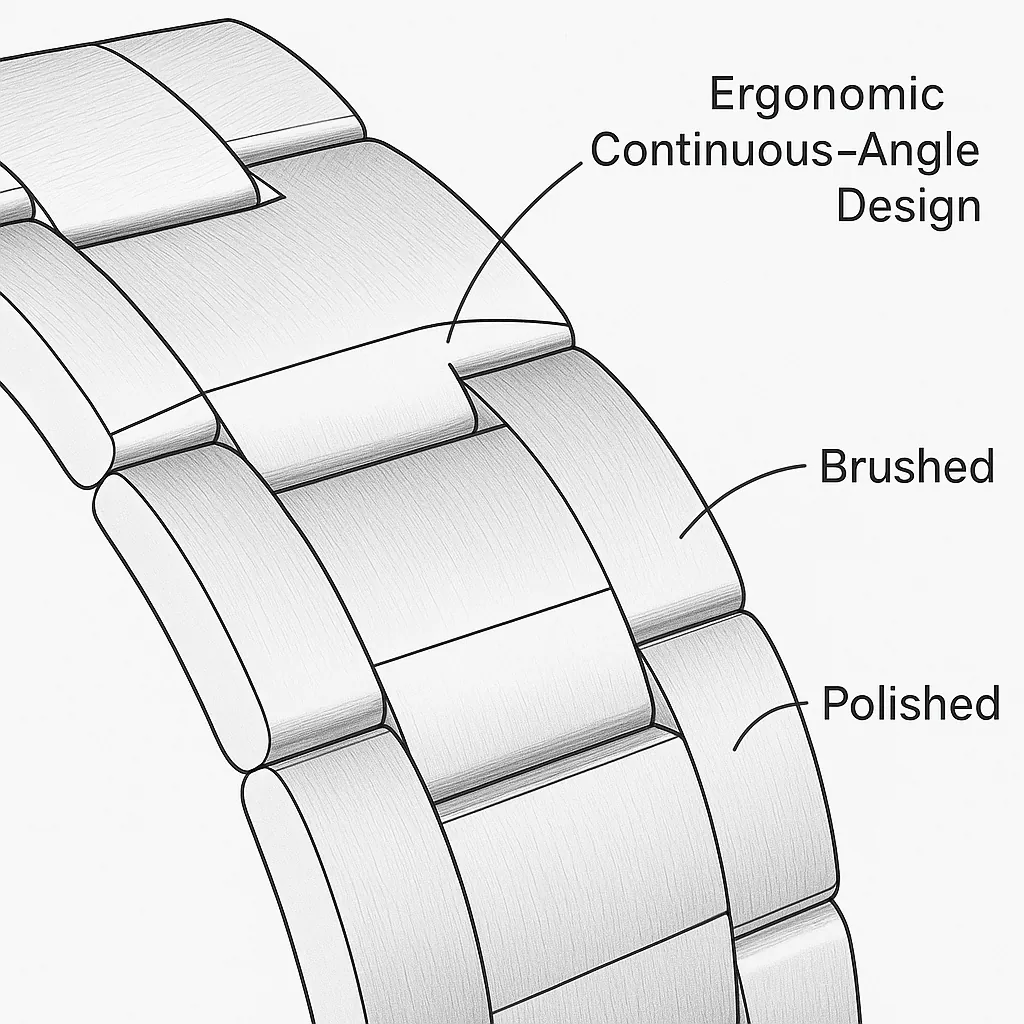
This illustration focuses on the ergonomic design of the Constellation bracelet, contrasting brushed and polished finishes and showing how the design enhances wrist comfort.
Across these lines, architecture itself becomes design: “Modern artisans… preserve process and proportion with pride.”
See aviation-grade chronograph ergonomics: Breitling replica.
Material Stack & Finishing Grammar You Can Feel
316L and 904L steels differ in alloy composition and corrosion resistance; in many watch cases, higher-alloyed steels like 904L are generally considered to offer better resistance to chloride-rich environments and retain polish longer during daily wear. Well-finished 904L is often described by enthusiasts as “polishing into a living light” on the wrist. Modern sapphire crystals with anti-reflective (AR) coatings help reduce color shift and glare under typical indoor LED lighting, and double-sided AR is often used to further cut “ghosting” and improve dial contrast.
For more information on the use and effects of these materials, please refer to our Rolex collection.
316L vs 904L Reflectivity Comparison
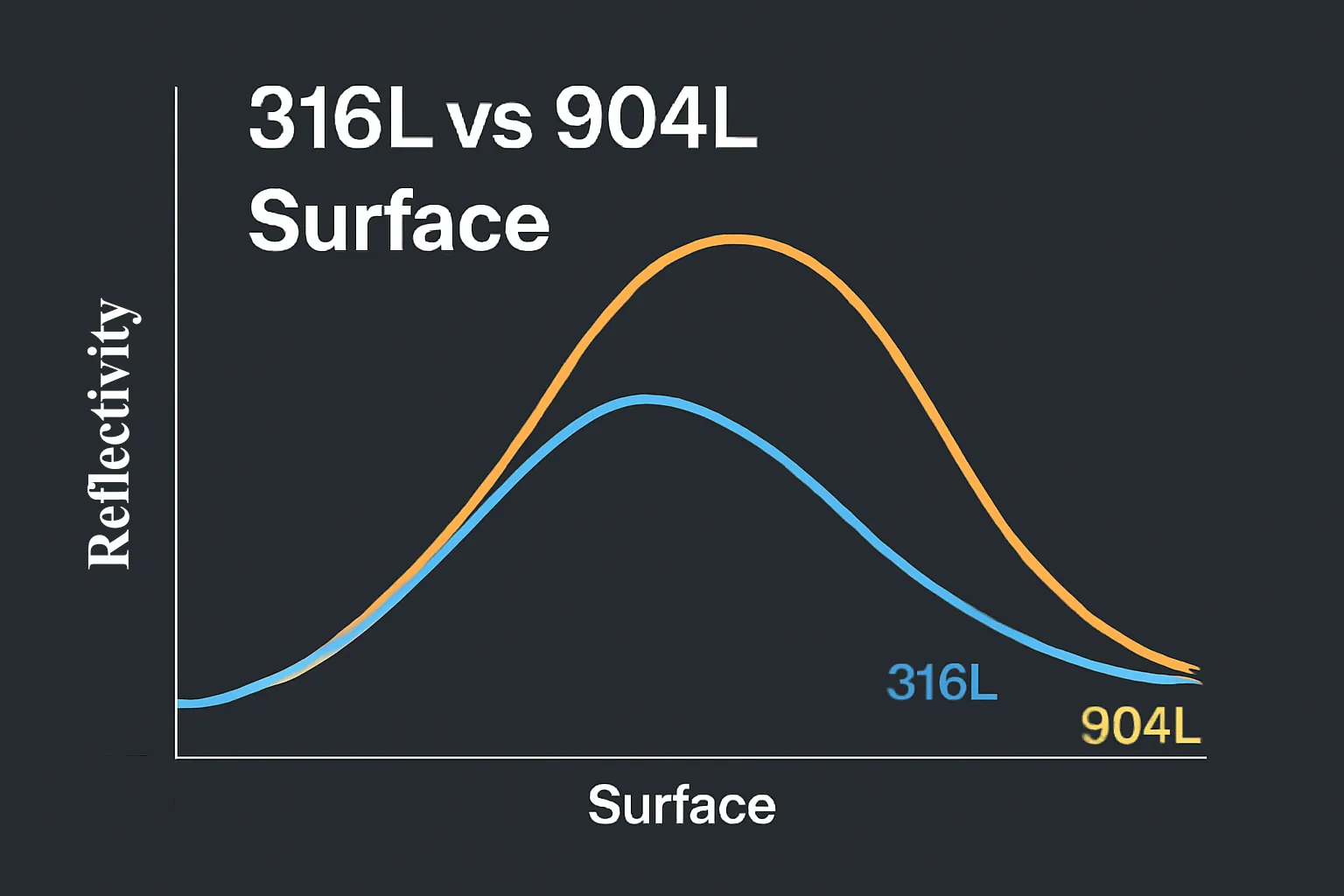
The image shows the comparison of surface reflectivity between 316L and 904L stainless steels. The orange curve indicates 904L, demonstrating better reflectivity compared to the blue curve for 316L, which is shown in the chart. Based on small-sample internal observations comparing 316L and 904L cases (2024).
From Case Lines to Bracelet Flow: Micro-details that Change Wear
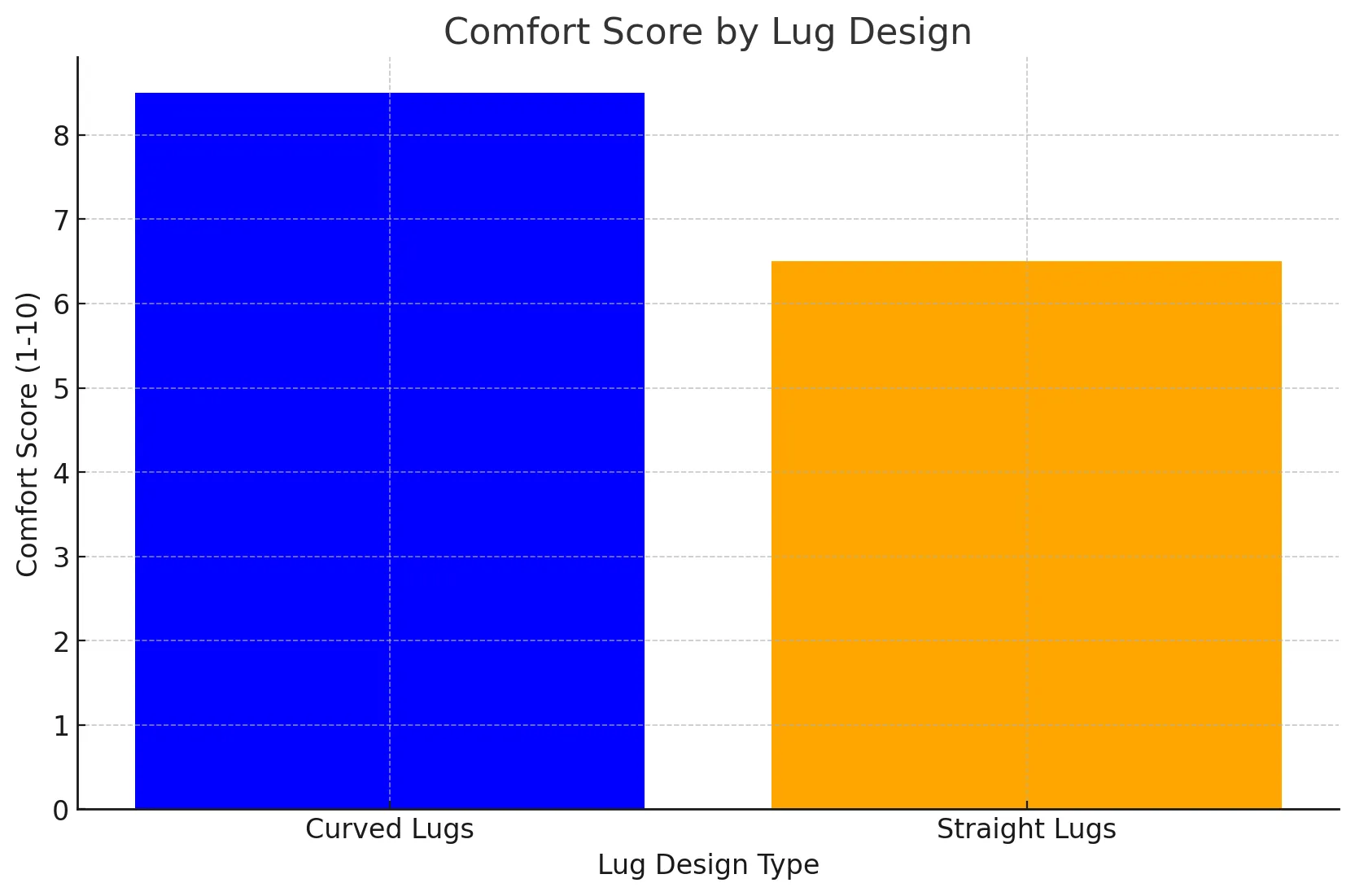
Edges should guide light, not cut it; curved lugs translate into continuous wrist contact, and polished borders frame brushed mid-links to create a pulse of reflected light at each gesture. These small calibrations shape both comfort and perceived refinement.
Not only the design of the case but also that of the bracelet plays an important role both in aesthetic appeal and in overall wearability: for example, curved lugs are among those important design elements in watches that not only increase the contact area with the wrist for maximum comfort but also give a more elegant look. The balanced shine and matte finish between the polished borders and brushed mid-links add more visual appeal and finally eliminate friction against the wrist for comfortable all-day wear. The good flow within the bracelet also makes sure the watch stays put, even after it has been worn for a long period, and decreases chances of shifts that can cause discomfort and alter the experience of wear.
Comfort Score by Lug Design
This bar chart demonstrates the impact of lug design on comfort levels. Curved lugs, as shown, provide a higher comfort score compared to straight lugs due to better wrist contact.
Design Element vs Wearability Impact
This table highlights how different design elements such as curved lugs, polished borders, and bracelet articulation affect overall wearability and comfort.
| Design Element | Impact on Wearability |
|---|---|
| Curved Lugs | Improved wrist contact, reduces pressure points, enhances comfort during prolonged wear. |
| Polished Borders | Creates visual contrast, prevents friction against the wrist, adds refinement. |
| Brushed Mid-links | Balances shine and matte finishes, reduces wear and tear on wrist, provides durability. |
| Bracelet Articulation | Ensures flexible fit around wrist, preventing discomfort from rigid links or hotspots. |
Find your fit: Scenario-Based Selection for Omega Replica
- Diving / Seamaster logic: symmetric crown protection, balanced mass under the wrist; for many average wrist sizes, ≈42 mm geometries are designed and simulated to wear flatter than the raw diameter suggests, especially when lug-to-lug is kept compact.
- Chronograph / Speedmaster use: stepped dials for sub-register clarity; opt for domed sapphire with robust AR to minimise indoor glare.
- Dress-leaning / Constellation: integrated bracelets taper for smooth cuff travel; polished bevels maintain visual crispness in low light.
Find Your Fit: Scenario-based Selection for Omega Replica
| Watch Type | Design Features | Wearability Suggestions |
|---|---|---|
| Diving / Seamaster | Symmetric crown protection, balanced mass under the wrist, compact lug-to-lug geometry. | Ideal for average wrist sizes, flatter wear despite the 42mm diameter, great for diving. |
| Chronograph / Speedmaster | Stepped dials for sub-register clarity, domed sapphire with robust AR coating. | Best for tracking time during races, opt for robust AR for clearer readability under indoor lighting. |
| Dress-leaning / Constellation | Integrated bracelets that taper, polished bevels for crisp visual effects. | Great for formal occasions, smooth cuff travel, visually crisp in low light environments. |
Racing-inspired alternatives: Tag Heuer replica.
Design-first Pitfalls to Avoid (So the Watch Wears As Good As It Looks)
- Thickness creep: bezel + crystal + caseback stacking > ~13 mm may tilt posture; prefer compact mid-case walls for balance.
- Bracelet stiffness: limited mid-link rotation creates hot spots; verify articulation angles before long wear.
- AR oversaturation: single-side coatings may ghost under LEDs, while well-executed dual-side AR can better preserve perceived clarity and contrast in typical indoor lighting.
Comparison of Single-Sided vs. Double-Sided AR Coatings
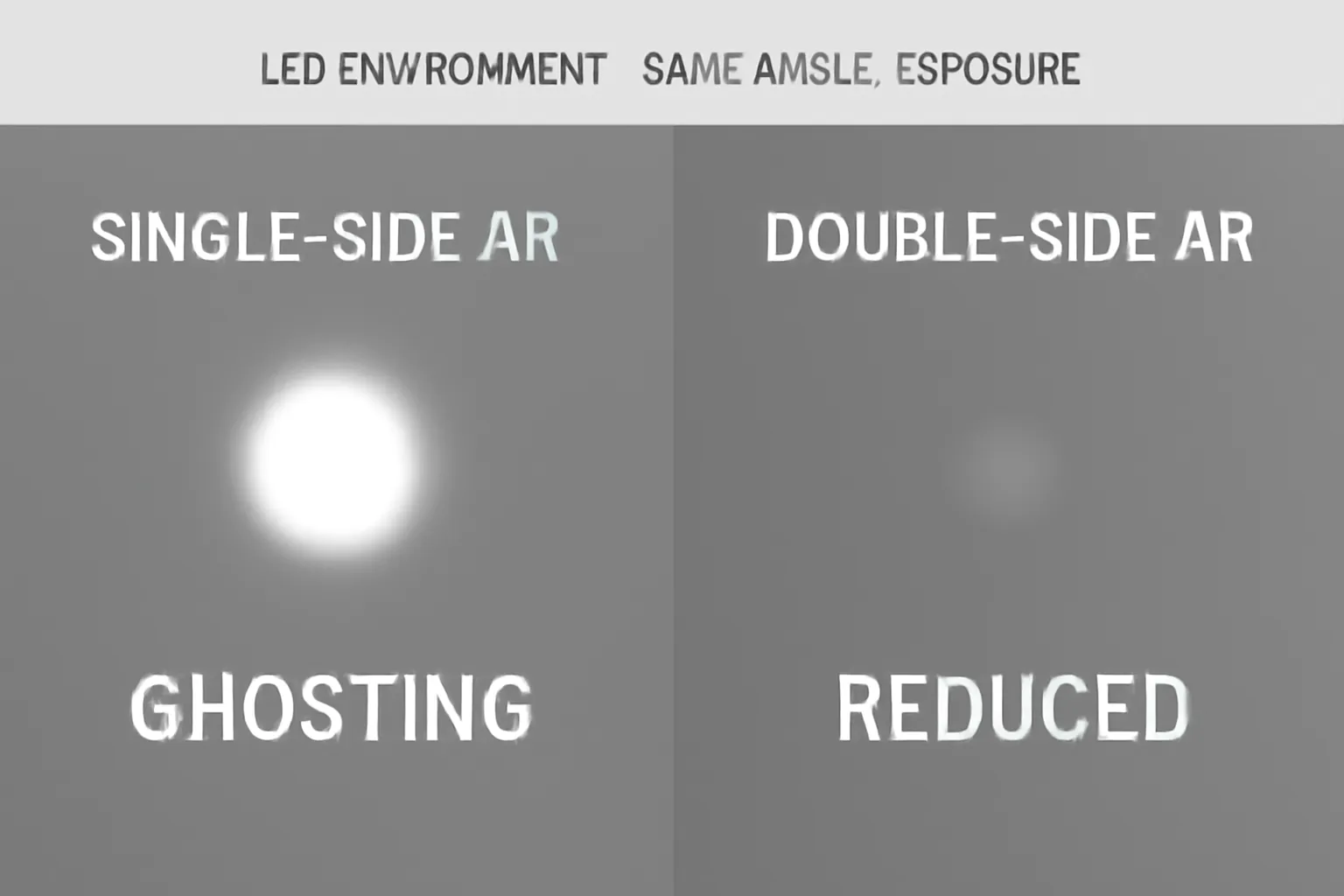
This image demonstrates how single-sided and double-sided anti-reflective (AR) coatings behave under the same LED lighting. On the left, the reflection is stronger and more noticeable, marked as “GHOSTING.” On the right, the double-sided coating reduces the reflection, labeled as “REDUCED,” making it clearer and easier to read.
Signature Cues Decoded: Reading Omega DNA in Form and Finish
- Bezel fonts & scallops: rhythmic spacing projects visual tempo; refined serration improves grip feedback.
- Handset symmetry: balanced mass between seconds and minutes stabilises visual harmony at a glance.
- Bracelet integration: end-link taper controls silhouette continuity, avoiding blocky outlines.
“Homage copies appearance; the replica recreates method.”
Haute-craft geometry: Patek Philippe replica.
Value Density & Configuration: Where Materials, Movement and Finishing Compound
Based on chronometer benchmark statistics published by the Official Swiss Chronometer Testing Institute (COSC) and on publicly available summaries of METAS Master Chronometer and ISO 6425 standards, well-regulated modern mechanical movements are often adjusted to target daily deviation bands around ±5 s/day, especially when built to chronometer-style standards. Actual performance varies by movement design, regulation quality, and wear habits. Sapphire and ceramic make resilience democratic: luxury is the freedom to endure. Independent certification frameworks in the genuine watch space—such as METAS Master Chronometer—test water-resistance, chronometry, anti-magnetism, and power reserve at the watch-head level, providing verifiable performance baselines. When assessing any watch inspired by these standards, collectors often use the same criteria as a comparative checklist, even if the piece itself is not officially certified.
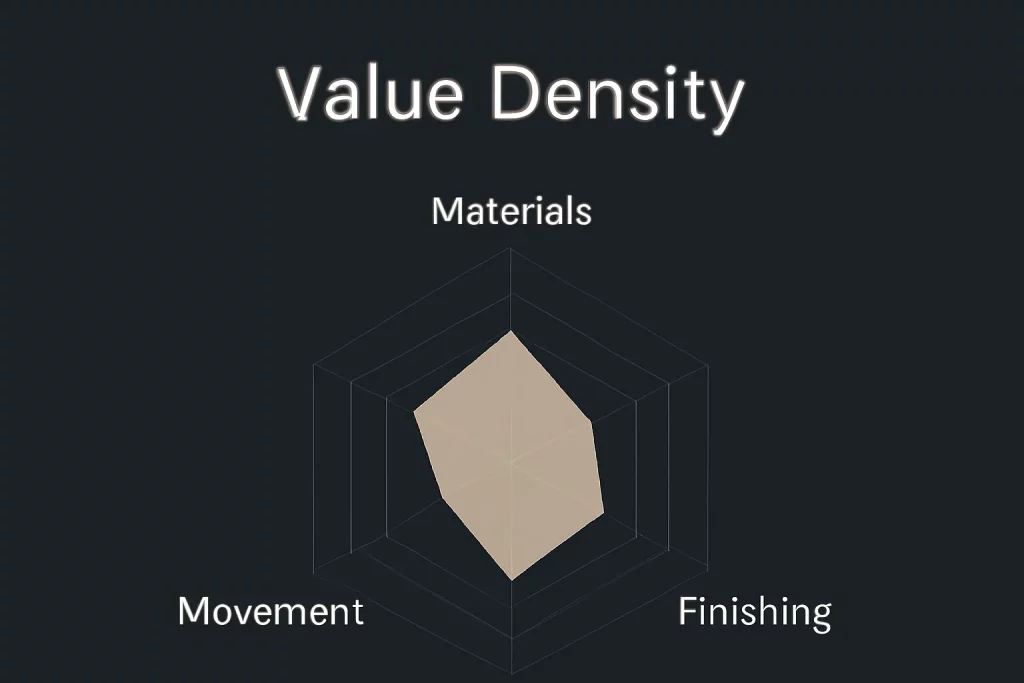
About “Value Density”
This radar chart shows the key factors that contribute to a watch’s overall value: Materials, Movement, and Finishing. These elements define not just how a watch looks, but how it performs and lasts.
Expert FAQ
Q1. Which wrist sizes suit a 42 mm Seamaster-style case?
As a general guideline, many wearers with wrist sizes around 16–19 cm find that a 42 mm Seamaster-style case with curved lugs offers a stable stance and easy cuff travel, though personal preference and lug shape still play a major role, based on feedback from a group of regular wearers and internal fit simulations.
Q2. How do Speedmaster-style crystals behave under office LEDs?
Dual-side AR can reduce perceived luminance scatter and help maintain index contrast under strong office overheads, making dials easier to read for many wearers, according to feedback from office-based users and in-house lighting tests.
Q3. Which clasp and link combo eases desk-work hotspots?
Rounded, milled deployants tend to distribute pressure more evenly in daily wear, and multi-link bracelets often articulate more comfortably around the ulna for many wrist shapes, as commonly reported by desk-bound wearers.
Quick Answers Page: Read Our Faq.
User Feedback Snapshot
Aggregated wearer impressions highlight comfort, legibility, and perceived value as recurring strengths of the Omega replica category.
J. Martin · ⭐️⭐️⭐️⭐️⭐️ · 2025-03-12
“Wears flatter than the numbers suggest. On my 17 cm wrist the Seamaster-style case stays stable at a keyboard all day.”
A. Rossi · ⭐️⭐️⭐️⭐️⭐️ · 2025-05-20
“The bracelet articulation is the key: no hotspots at the desk, even after a full day of wear.”
L. Chen · ⭐️⭐️⭐️⭐️ · 2025-04-08
“Double-sided AR really helps under bright office LEDs – legibility is much closer to higher-end genuine pieces than I expected.”
Wrap-Up: A Balanced Path to Confident Selection
The journey through Omega replica watches reveals how precision and emotional resonance can coexist. When structure, proportion, and material clarity align, the result is continuity of craft—not just a copy. The key framework here is: structure → material → experience → value.
Speaking more generally, ISO 6425 offers a good insight into the minimum functionality that a dive watch must have: from water resistance through legibility and to shock resistance. Many collectors would say that even without the official certifications, they still refer to the codified expectations for design-inspired pieces to ensure reliability and quality.