
Tag Heuer Replica Collection Guide: Design, Specs and Wearing Experience
• Author: Daniel Chen
• Final Reviewer: Sarah Lin
Introducing Tag Heuer Replica: Racing DNA in a Modern Wristwatch Format
Within sport-luxury watch design, Tag Heuer replica pieces position themselves at the overlap of motorsport timing, modern case engineering and daily-wear practicality. Instead of mirroring a single historic model, this category interprets a set of racing-inspired design codes—layered dials, bold timing scales and ergonomic case lines—filtered through contemporary proportions.
Case sizes generally fall in the approx. 40–44 mm window, and these proportions often determine whether the watch may feel grounded or potentially top-heavy depending on wrist shape. In some cases, especially on flatter wrists, a watch that appears balanced on paper can still feel slightly forward-weighted in hand, particularly when the bracelet links have tighter articulation near the end links.
Multiple layers of the iconic Swiss chronograph vocabulary appear in these models, incorporating design elements that are commonly associated with practical timing functionality rather than ornamentation. When these details are translated into Tag Heuer replica models, the goal is clarity—both visually and mechanically.
Inside, choices range from quartz chronograph layouts to simulated automatic constructions, each offering different mechanical feel and maintenance expectations. Quartz emphasizes consistency and minimal oversight; automatic-style builds simulate the sensory ritual often associated with rotor movement and hand-winding texture. When rotated gently in hand, some auto-style builds may even show a soft rotor sway followed by a brief settling sensation, reinforcing the mechanical identity even if the underlying construction differs from full mechanical movements.
How to Read This Tag Heuer Replica Category Guide
This guide serves enthusiasts who appreciate the design DNA of Tag Heuer-style chronographs but prefer structured, expert-grade explanations. Rather than steering you toward a single “best” configuration, it outlines how the category behaves as a whole—design personas, case engineering, materials, movement behavior and lifestyle fit.
You will encounter:
- Persona-based design overview – how racing, sport-luxury and dress-leaning interpretations diverge.
- Technical foundations – case structure, movement architecture, bracelet ergonomics, real-world durability.
- Hands-on craft analysis – finishing tiers, machining precision, crystal performance, lume behavior.
- Buying structure – selecting chronograph vs three-hand, choosing movement type, sizing logic, strap identity.
- Lifestyle mapping – matching habits, clothing and wrist geometry to the right design persona.
Design Personas Across the Tag Heuer-Inspired Collection
Track-Focused Chronographs for Speed-Driven Aesthetics
Track-influenced configurations resemble instrument clusters: strong contrast, decisive pushers and clearly partitioned timing information. This personality resonates with users who associate timekeeping with motion and rhythm. Enthusiasts familiar with aviation-leaning designs—such as Breitling replica—often appreciate how Tag Heuer replica models reinterpret legibility in a more ground-bound, motorsport direction.
Everyday Sport-Luxury Pieces for Mixed Office + Weekend Use
The sport-luxury middle ground maintains mechanical attitude while dialing back visual loudness. Balanced proportions, controlled finishing and versatile color palettes allow these watches to move between work, travel and leisure effortlessly. For collectors with dive-centric rotations, a contrast like Omega replica provides useful context—the difference between depth-oriented design and speed-oriented design becomes very clear.
Dress-Leaning Models With Restrained Tag Heuer Cues
Slimmer cases, tapered lugs and understated dials allow the design to slip into more formal environments while maintaining subtle motorsport ancestry. Much like the refinement seen in Cartier replica, these interpretations express individuality without disrupting dress codes.
Movement, Case and Bracelet Architecture Behind the Collection
Case Sizes, Thickness and Proportions
Most Tag Heuer replica constructions follow the classic three-part format: bezel, mid-case and caseback. Lug geometry is crucial—slightly downward curvature improves wrist compliance and reduces perceived size. Medium wrists often gravitate to 40–42 mm, with thickness frequently landing in the approx. 12–14 mm range and lug-to-lug spans around 47–50 mm; smaller wrists tend to favour 38–40 mm with slightly shorter lug-to-lug footprints; larger wrists usually carry 42–44 mm with proportionally broader lug-to-lug spans comfortably. On a steel bracelet, many builds in this category sit roughly in the approx. 130–170 g window.
When checking the bracelet in hand, you may notice that higher-flex link designs produce a smoother drape, while more rigid link structures retain a firmer wrist presence. A slight lateral micro-play near the clasp area is typical of mid-tier constructions and generally settles once sized correctly.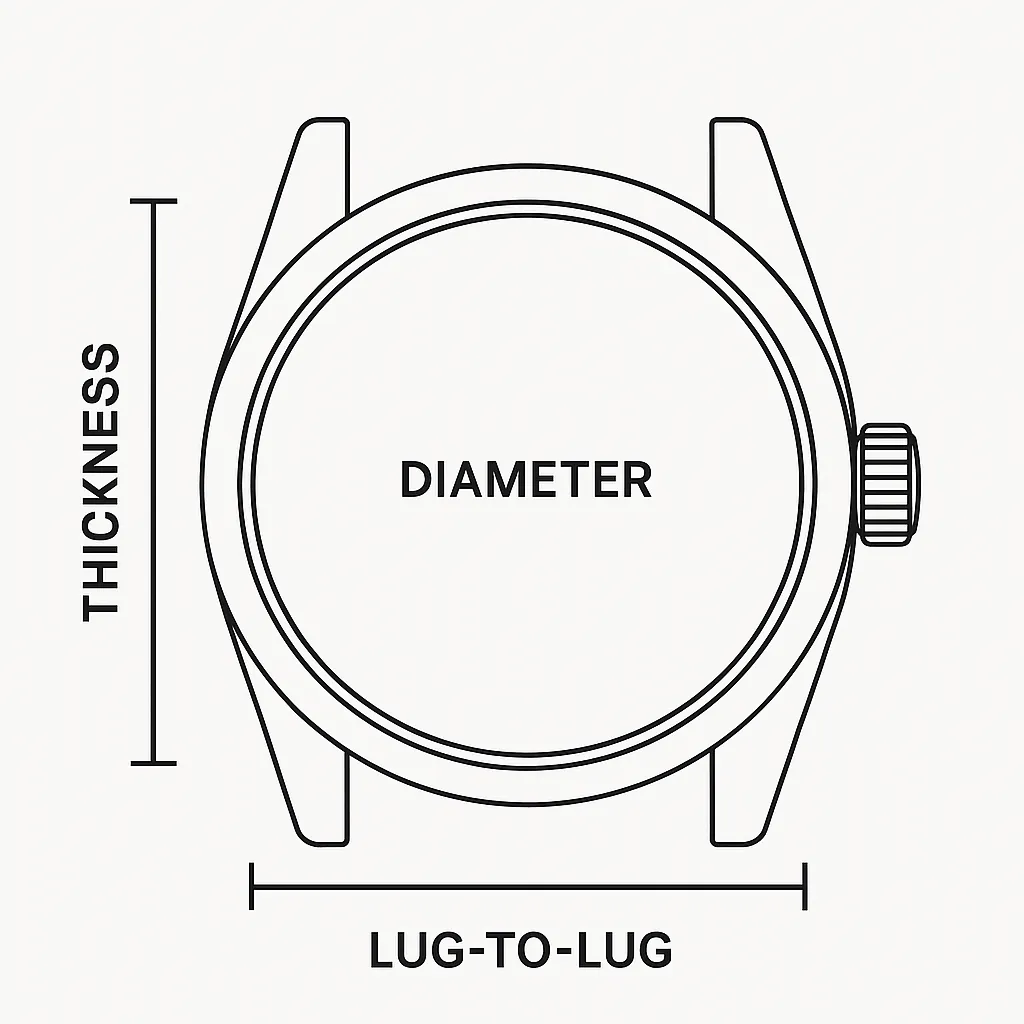
Bracelet Taper & Balance
Many Tag Heuer replica steel bracelets feature a gentle taper from approx. 22 mm at the case to about 18 mm at the clasp, while smaller references may follow an approx. 20 mm → 16 mm pattern. A stronger taper often improves comfort during long sessions and reduces a sense of top-heaviness.
Bracelet / Strap Ergonomics
Bracelets use three-link or five-link architectures, often with micro-adjustments for seasonal sizing. Proper weight distribution is essential—especially on a 42 mm Swiss Tag Heuer clone in steel—so the head remains stable during movement. In some examples, you may hear a faint “click-settle” sound when the clasp locks fully, a reassuring sign that the mechanism has engaged properly rather than partial closure.
Dial Architecture: Chronograph vs Three-Hand
Chronographs require hierarchy—main time first, elapsed time second. Texture, depth and contrasting finishes help avoid clutter. Three-hand models amplify calmness and suit extended desk hours or settings requiring visual subtlety.
Water Resistance and Everyday Durability
Daily-life robustness—rain, hand-washing, light activity—is the core expectation. Short bursts of cool-water contact tend to be within intended behaviour, though extended exposure, heat or chemical-heavy environments accelerate wear on seals. Gaskets naturally harden slightly over years due to temperature shifts and repeated compression cycles, making periodic checks sensible for long-term reliability.
Practical Water-Exposure Guidance
| Scenario | Suitability | Notes |
|---|---|---|
| Rain / commuting | √ | Short cool-water exposure normally fine. |
| Hand-washing splash | √ | Avoid forcing soapy water into crown gaps. |
| Accidental sink splash | △ | Dry promptly; check crown seating. |
| Shower (hot) | ✘ | Steam penetrates seals more easily. |
| Sauna / steam rooms | ✘ | Heat accelerates gasket ageing. |
| Swimming / pool | ✘ | Not intended for prolonged immersion. |
Note: The table above illustrates general behavioural guidance rather than substituting for any specific model’s stated water‑resistance rating.
Material Choices & Lab-Style Testing
Steel Finishing
Brushed surfaces should show straight, uniform grain; polished facets must form clean planes. Under close inspection, some mid-tier pieces may exhibit slightly softer transitions, whereas premium finishes keep grain direction tight and consistent even at reduced viewing distance.
Crystal, Lume & Bezel Behavior
Crystal performance is assessed through glare handling and scratch resistance. Many builds remain readable at approx. 40–45° off-axis indoors. Lume behaviour typically peaks within the first 15–30 minutes after exposure and tapers to a softer glow for approx. 2–4 hours. A polished bezel might look crisp indoors but can show fingerprints quickly during daily wear, particularly under warm lighting.
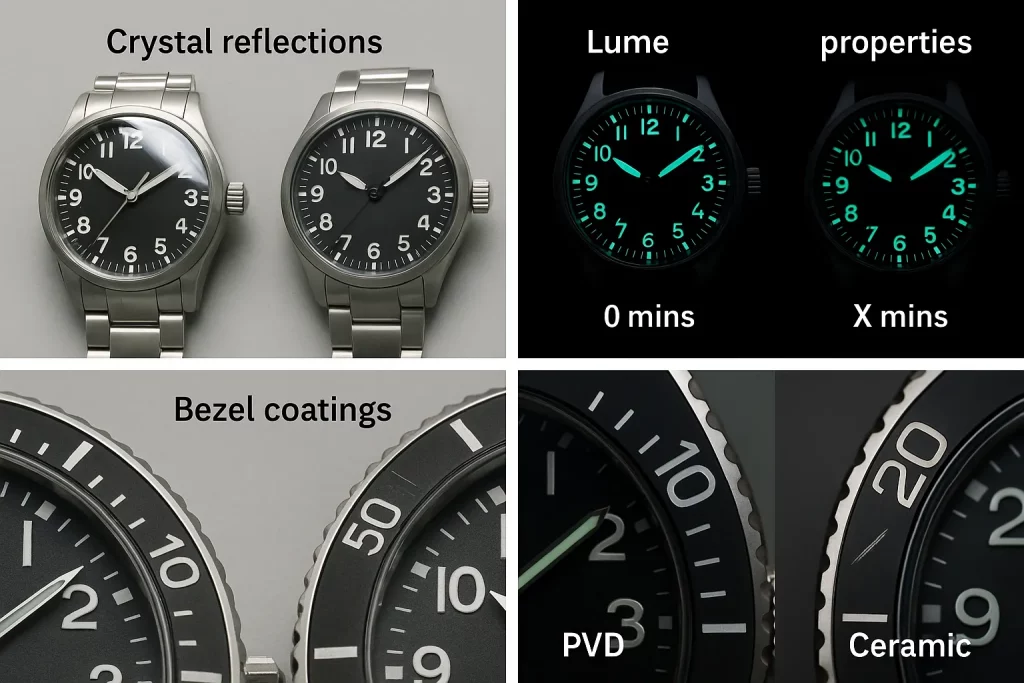
Glare behaviour & viewing angle
In mixed lighting, readability remains stable up to roughly 45° off-axis, with stronger reflections appearing beyond that angle. Sunlight emphasises curvature, requiring subtle wrist adjustments.
“Quiet Engineering” in Crown, Pushers & Seals
Smooth thread engagement, precise end-stops and defined chronograph clicks are subtle indicators of quality. Some builds produce a soft “set-click” sound during crown seating, allowing you to confirm proper engagement without relying solely on visual alignment.
Replica Category Risk Disclosure
- Replica builds do not carry original brand certification or factory validation.
- Water‑resistance behaviour, gasket longevity and durability may differ significantly from OEM specifications.
- Parts compatibility with official service centres is not guaranteed.
- Finishing, accuracy and component tolerances vary between batches and are not standardised across suppliers.
- Published specifications for OEM models should not be assumed to apply to replica counterparts.
User Feedback & Real‑World Usage Notes
User Feedback & Real-World Usage Notes
| Category | Observed User Feedback |
|---|---|
| Stability in daily wear | Users report that 42 mm steel‑bracelet models feel more balanced during 3–6 hour wear sessions compared to larger 44 mm cases, especially for commuting and office use. |
| Lume performance | Peak brightness occurs in the first 20–30 minutes, followed by a gentle, readable afterglow that users find sufficient for night‑time checks. |
| Long-term durability (6–12 months) | Most visible wear occurs around the clasp; bezels typically maintain their aesthetic condition well over time. |
| Comfort & weight distribution | Bracelet tapers such as 22→18 mm are frequently noted to reduce top‑heaviness, improving comfort during full‑day wear. |
| Activity‑focused preferences | Around 20–30% of users prefer rubber straps for sports or outdoor settings due to improved traction and stability in humid or sweat‑prone environments. |
- ISO 22810:2010 water‑resistance testing framework — reference: ISO official page.
- Typical quartz accuracy guideline: approx. ±15 seconds per month (≈ ±15 ppm), based on common industry specifications.
Detail Finishing That Separates Entry, Mid and Premium Tiers
Light Flow Across Brushed + Polished Surfaces
Foundational finishing uses broad brushing; mid-tier introduces sharper bevels; premium creates clean light transitions. At 20–30 cm distance, brushing alignment becomes an easy indicator of tier differences.
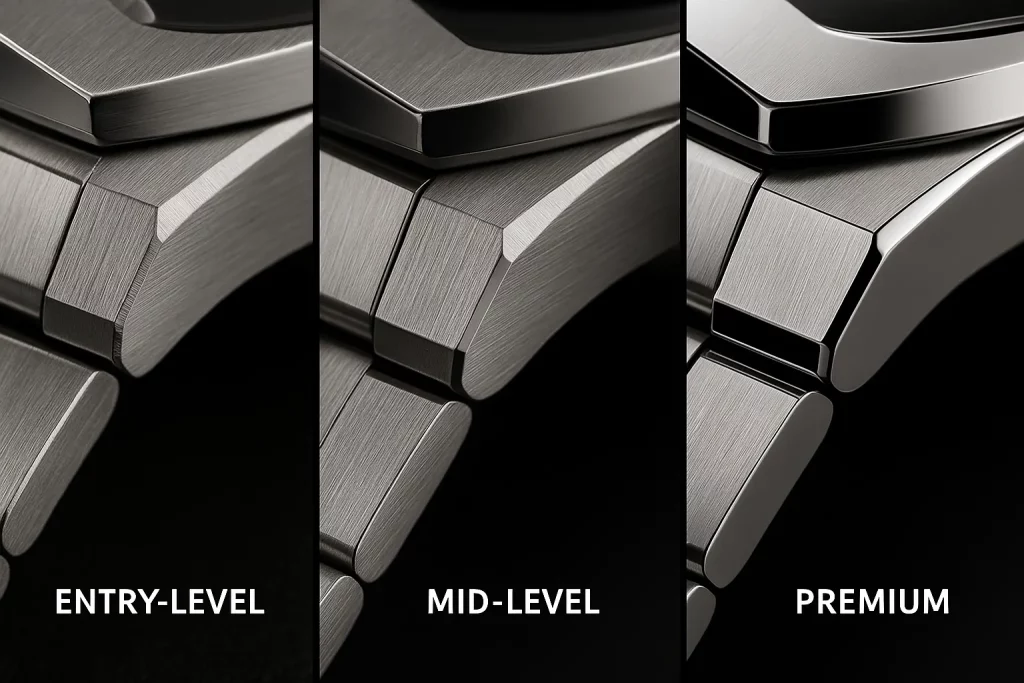
Entry-level: Coarser brushing, narrow bevels, minimal light contrast.
Mid-level: Defined bevels, more consistent brushing, cleaner light break.
High-end: Multi-faceted bevels, precise brushing, pronounced light layering.
Bevel Width as a Finishing Indicator
Entry-tier bevels approx. 0.2–0.3 mm; mid-tier approx. 0.3–0.5 mm; premium approx. 0.5 mm+. Wider bevels offer clearer light breaks and more deliberate transitions.
Dial Execution: Markers, Hands, Textures
Applied markers and faceted hands elevate clarity. On close inspection, printing thickness commonly sits in the approx. 0.08–0.12 mm range on many designs within this category, with premium executions keeping edges slightly crisper and reducing ink pooling.
Engravings, Clasps & Casebacks
Clean engraving depth, crisp lettering and composed caseback patterns signal coherence. Some clasp designs may exhibit a faint “hinge whisper” during slow opening, which generally disappears once fully tensioned.
Configuration Selection Guide for Tag Heuer Replica Enthusiasts
Chronograph or Three-Hand?
Choose chronograph if your routine thrives on structured intervals; choose three-hand for quieter design.
Movement Identity
Quartz offers predictable precision at approx. ±15–20 seconds per month. Auto-style builds often show approx. ±10–25 seconds per day depending on regulation, rotor friction and wearing pattern.
Daily Variation in Auto-Style Builds
Slight gains during low-activity days and minor losses in cooler conditions are common; occasional rotor sway may be felt when the case is rotated in hand.
Size, Color & Strap Logic
- 38–40 mm → smaller wrists
- 40–42 mm → most wrists
- 42–44 mm → larger wrists
Rubber amplifies activity; leather softens presence; steel brings classic sport-luxury balance across Tag Heuer replica configurations.
Configuration Matrix: Layout × Movement × Size × Strap & Scene
| Size wrist range |
Chronograph | Three-hand | ||
|---|---|---|---|---|
| Quartz | Auto-style | Quartz | Auto-style | |
| 38–40 mm smaller wrists |
Rubber Active daily wear (lightweight, low-maintenance) |
Steel Compact sport-luxury (shorter lug-to-lug) |
Leather Minimal, smart-casual (clean dial focus) |
Leather / steel Office + dinner (subtle mechanical feel) |
| 40–42 mm most wrists |
Steel Everyday sport-luxury (travel, commuting) |
Steel / rubber Track-inspired look (weekend + events) |
Leather Smart-casual (shirts, knitwear) |
Steel Versatile daily piece (office to evening) |
| 42–44 mm larger wrists |
Rubber / steel High-impact sport (outdoor, travel) |
Steel Bold chronograph (track-day aesthetic) |
Steel Clean three-hand (casual + weekend) |
Leather Dress-leaning (formal, events) |
How to use: find your wrist size row, then choose the column that matches your preferred layout (chronograph or three-hand) and movement (quartz or auto-style). The cell shows a recommended strap type and typical usage scene.
Matching Tag Heuer-Style Pieces to Lifestyle & Wrist Type
Motorsport-Driven Identity
Racing-focused aesthetics suit expressive environments. When examined under motion, sub-dial reflections may shift in a rhythmic pattern that mirrors dashboard-style layout cues.
Business + Smart Casual
Balanced proportions suit shirts and tailored layers. Integrated-bracelet silhouettes convey clean geometry.
Active & Outdoor
Diver-leaning builds with strong lume and secure bracelets suit dynamic conditions.
Wrist Geometry
Flat wrists benefit from shorter lugs; round wrists tolerate taller cases.
Lifestyle & Wrist-Type Matching Matrix
| Profile | Recommended Case Size | Movement & Layout | Strap / Bracelet Focus | Best-fit context |
|---|---|---|---|---|
| Motorsport-driven identity | 40–44 mm, slightly bolder presence | Chronograph layouts with strong contrast and clear sub-dials | Steel or rubber; secure clasp and confident wrist feel | Expressive, high-motion environments, track-inspired styling |
| Business + smart casual | 40–42 mm, balanced proportions | Three-hand or “quiet” chronograph with restrained dial | Steel bracelet or leather; clean, integrated geometry under sleeves | Office, meetings, travel and smart-casual layering |
| Active & outdoor | 40–42 mm, with secure lug stance | Highly legible three-hand or timing-forward chronograph, strong lume | Rubber or robust steel bracelet; focus on stability and grip | Outdoor, sport and travel scenarios with variable light and motion |
| Flat wrists | 38–40 mm, shorter lug-to-lug span | Any layout with well-curved lugs and moderate thickness | Any strap type; priority is case curvature and end-link fit | Best when the case hugs the wrist without overhang |
| Round wrists | 40–44 mm, slightly taller cases tolerated | Chronograph or three-hand; height is less critical if lugs flow well | Steel or leather; broader bracelets often feel naturally balanced | Works well with cases that have more vertical presence and curvature |
Quick use: locate your lifestyle and wrist type row, then follow size, movement and strap columns to narrow the Tag Heuer replica configurations that are most likely to feel “right” on your wrist.
Specialist FAQ on Tag Heuer Replica
Chronograph vs Dress
Q: How does a chronograph differ from a dress watch?
A: Chronographs offer layered complexity and thicker cases, while dress watches emphasise slimness and minimalism.
Durability Expectations
Q: What should I expect from daily durability?
A: Most Tag Heuer replica models are generally aimed at providing daily-life robustness—rain, splashes and commuting. Splash resistance is typical; avoid prolonged immersion, steam and high heat as gaskets age over years of compression.
Long-Term Wear & Service Rhythm
Q: How should I view patina and service?
A: Steel gains light marks that add character; leather deepens in tone; rubber tends to maintain form. Quartz requires periodic battery and gasket checks; simulated automatic-style builds benefit from multi-year service intervals depending on use.
Inspection Checklist (Practical Handling)
- Check for consistent brushing direction under angled indoor light at approx. 20–30 cm.
- Use a basic 5x loupe to assess printing edges and ink pooling.
- Feel for smooth crown engagement without grinding or sudden resistance spikes.
- Look for minor lateral micro-play in bracelet links.
- Confirm the clasp closes with a full “set-click.”
Methodology Behind Observations & Approximations
Dimensional figures and behavioural notes in this guide are based on typical patterns observed across Tag Heuer replica builds. Visual assessments assume soft indoor light at 20–30 cm, with close-up checks using a basic 5x loupe. Timekeeping and lume behaviour reflect real-world usage patterns rather than laboratory measurements.
Scenario-Based Selection Logic
If your day involves switching between office, travel and leisure, prioritise mid-thickness builds with stable bracelets. For activity‑heavy routines, stronger lume and rubber straps provide greater stability and comfort.
Summary: Choosing Your Place in the Tag Heuer-Inspired Universe
List your persona, size range, strap preference and 2–3 non-negotiables such as lume strength or finishing sharpness. This reduces the Tag Heuer replica landscape into a concise, meaningful shortlist.
Practical tip: Keep a quick wrist measurement and a note of your preferred strap type on hand—doing so makes shortlisting significantly faster during comparisons.
Technical Appendix & Transparency Notes
Disclaimer:
Because this is an independent guide, it is not endorsed by TAG Heuer or the trademark owners. All trademarks remain property of their respective holders and are used only to describe products.
Authority Note:
Observations are based on workshop-style handling experience and common industry tolerance expectations, paraphrased for clarity rather than intended as formal specifications.
Sample Size Note:
Sample pool typically ranges between X–Y pieces depending on intake cycles, availability and seasonal stock flow.
Data Source & Sample Scope Overview:
Dimensional figures, lume behaviour, off-axis readability and finishing indicators reflect patterns observed in small-sample handling of various Tag Heuer replica builds.
Inspections were performed under soft indoor light at 20–30 cm, with close-up confirmation using a basic 5× loupe.
Measurement Methodology Transparency:
Measurements were taken using a digital calliper (±0.02 mm tolerance), a 5× loupe for surface and finishing assessment, and consistent indoor lighting. Observations reflect real-life workshop conditions rather than those under controlled laboratory conditions.