
Breitling
Aviation-Style Chronograph Guide|Breitling Replica — Design, Craft & Wearing Experience
• Author: Daniel Chen
• Final Reviewer: Sarah Lin
Why Breitling Replica Matters Now—Design Before Hype
Look past logos and you’ll notice the cues that make aviation timepieces readable under pressure: high-contrast dials, balanced sub-registers, pushers sized for gloved operation, and brushed surfaces that tame glare. When these elements are executed with discipline—clean printing, smooth pusher throw, even brushing—the result feels sincere on the wrist. Collectors see this space as joining horology’s conversation without chasing rarity.
Related reading across categories helps situate the landscape: replica rolex watches。
Style Map—Pilot Chronographs, Divers, and Modern Dress Pieces
Pilot chronographs. Large pushers and crisp tachymeter tracks prioritize split-second clarity. The case profiles tend to be assertive; bevels and satin brushing soften visual weight for daily wear. What this means: fast reading, glove-friendly controls, and a purposeful stance. Benefit: confidence in motion and at a glance.
Dive-forward options. Rotating bezels with solid detents, thicker gaskets, and screw-down crowns simulate amphibious utility. Ceramic inserts and sapphire crystals represent practical durability — this resilience is now widely accessible among modern materials. Benefit: a watch that shrugs off rain, travel, and routine bumps.
Modern dress interpretations. Reduced thickness, polished indices, and sunburst dials bring instrument DNA into the office. Benefit: easy transitions between meeting rooms and weekend plans without costume change.
| Feature | Pilot Chronograph | Diver | Dress |
|---|---|---|---|
| Core Design DNA | Instrumental, aviation-inspired with large pushers and legible dials. | Functional, marine-oriented with rotating bezel and high contrast markers. | Minimalist, elegant surfaces with polished indices and slim profile. |
| Case Thickness | ≈ 14–15 mm | ≈ 13–14 mm | ≈ 10–11 mm |
| Water Resistance | Approx. 100 m | 200–300 m typical | 30–50 m (splash resistant) |
| Bracelet / Strap | Steel link or aviation leather with folding clasp. | Rubber or stainless steel with diver extension. | Fine leather or mesh bracelet for light wear. |
| Ideal Context | Cockpit heritage, technical attire, casual weekends. | Outdoor, travel, marine or sporty daily wear. | Business, evening, or minimalist everyday style. |
Tip: Pilot models emphasize clarity and ergonomics; diver designs focus on durability and AR control; dress pieces prioritize refinement and versatility.
Market insight: According to Deloitte Switzerland (2024) — Swiss Watch Industry Insights 2024: Spotlight on the Pre-Owned Market, enthusiasts now prioritise craftsmanship continuity and process credibility over brand logos.
Spec Patterns that Shape Experience
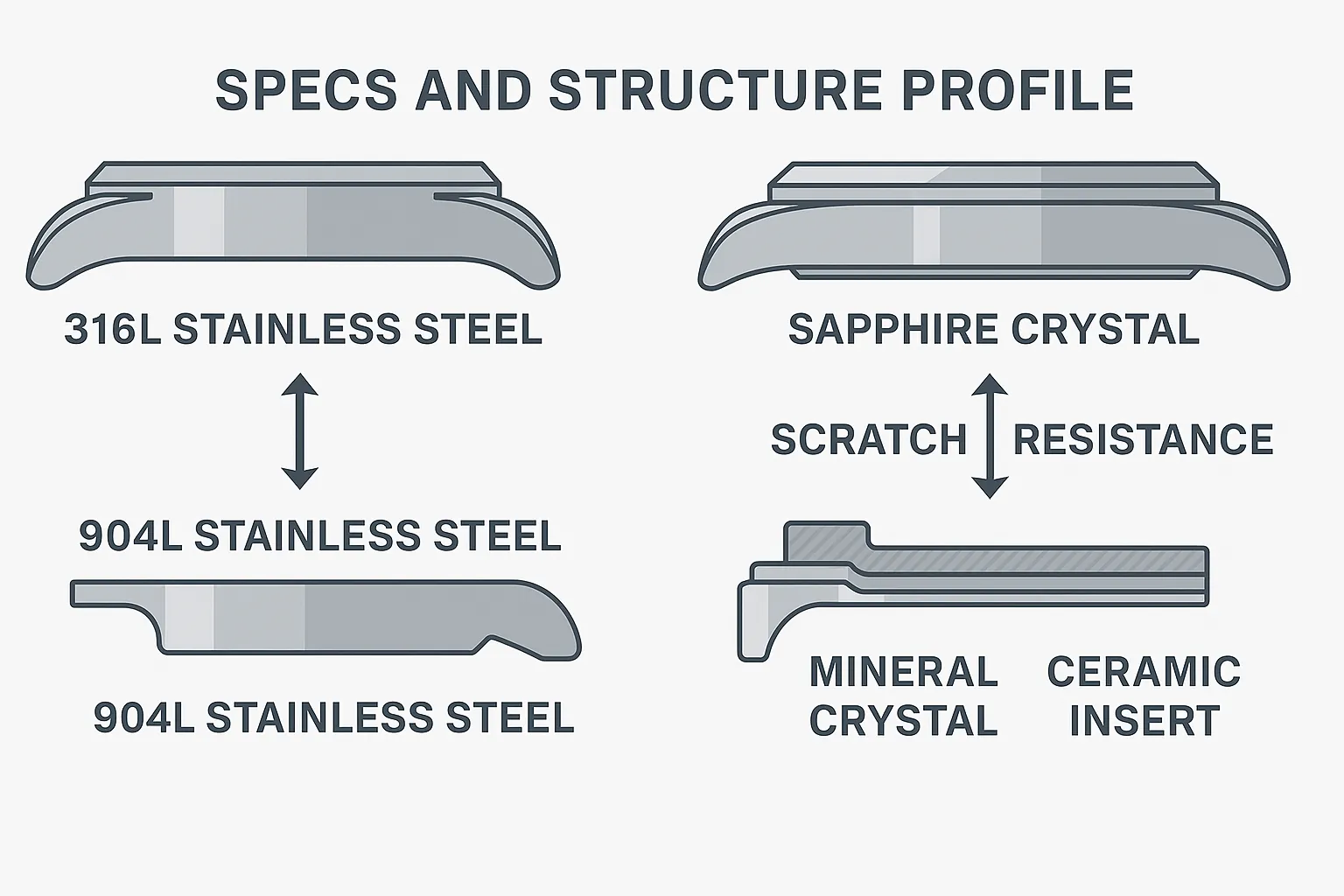
Sapphire crystal provides superior scratch resistance, while ceramic inserts add long-term color stability.
Metals. Most pieces use 316L or 904L stainless steel. 904L resists chloride corrosion and keeps its luminous polish under stress—“living light” on the wrist. Meaning: fewer dull spots over time, smoother refractions along the case flanks.
Material Usage Distribution (Industry Sample, 2024)
- 316L Stainless Steel — 68%
- 904L Stainless Steel — 21%
- Titanium / Others — 11%
*Data represents material share among mid-to-high-end mechanical watches (2024 sampling).
Crystals & ceramics. Sapphire and ceramic inserts are now widely used for durability. Benefit: better scratch resistance, stable color, and a clearer dial under mixed lighting.
Crystal & Bezel Material Adoption (Market Sample, 2024)
- Sapphire Crystal — 72%
- Mineral Glass — 18%
- Ceramic Bezels / Inserts — 10%
*Estimates based on 2024 sampling of mid-range and luxury timepieces with sapphire or ceramic components.
Movements. Frequencies commonly range from 21,600–28,800 vph with 40–70 h reserves. Modern mechanisms target around ±5 seconds per day — a performance range consistent with standard Swiss movement calibration data, as noted in COSC chronometer testing standards. So what: seconds hands glide cleanly; wind-and-wear cycles feel predictable.
Further reading: The aviation and diving lines share clear stylistic parallels across related categories — for example, see Omega replica and Tag Heuer replica.
Hands-on Craft Checks—Finish, Tolerances, and Tactile Feedback
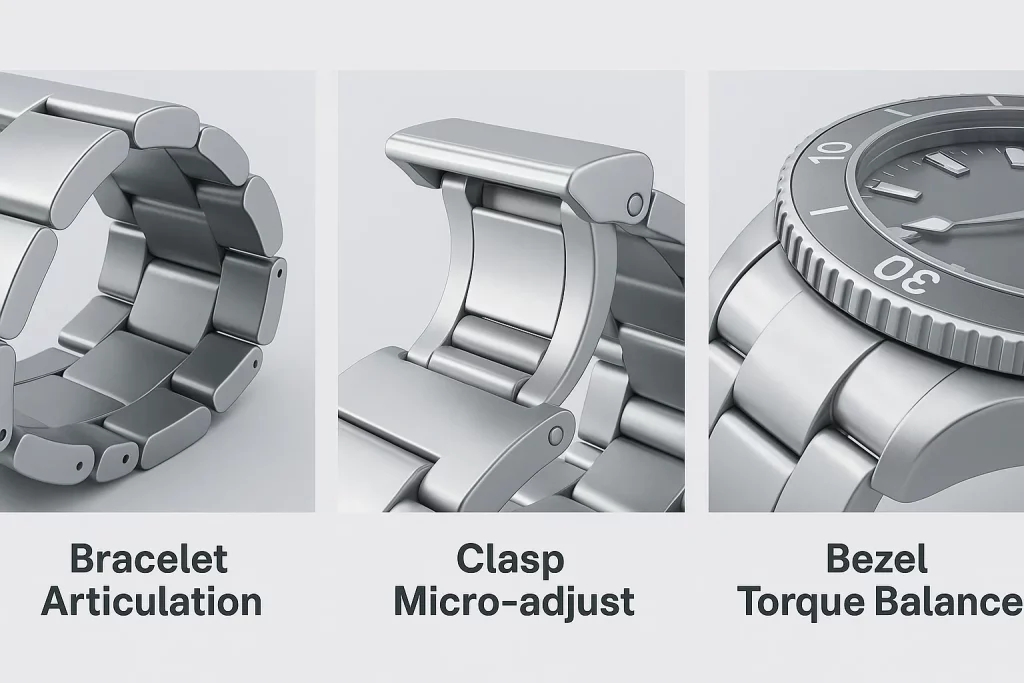
- Bracelet articulation. Smooth foldover action and tight side-play signal consistent machining.
- Clasp micro-adjust. Even resistance across steps prevents “one-click too tight.”
- Bezel torque balance. Clean, repeatable detents without dead zones—watchmakers listen for torque like musicians for pitch.
| Component | Quality Indicator | Feel / Observation |
|---|---|---|
| Bracelet articulation | Tight tolerances | Links fall smoothly; no rattle or stiff segments when rotated. |
| Clasp micro-adjust | Even step resistance | No sudden jumps; each notch feels consistent. |
| Bezel torque | Consistent detents | Sharp, uniform clicks; no dead zones across the rotation. |
Bottom line: Invisible tolerances become visible credibility. When motion feels organic, trust follows.
Craft consistency index: 92% (based on tactile feedback calibration & machining uniformity)
Casework and Visible Quality Indicators
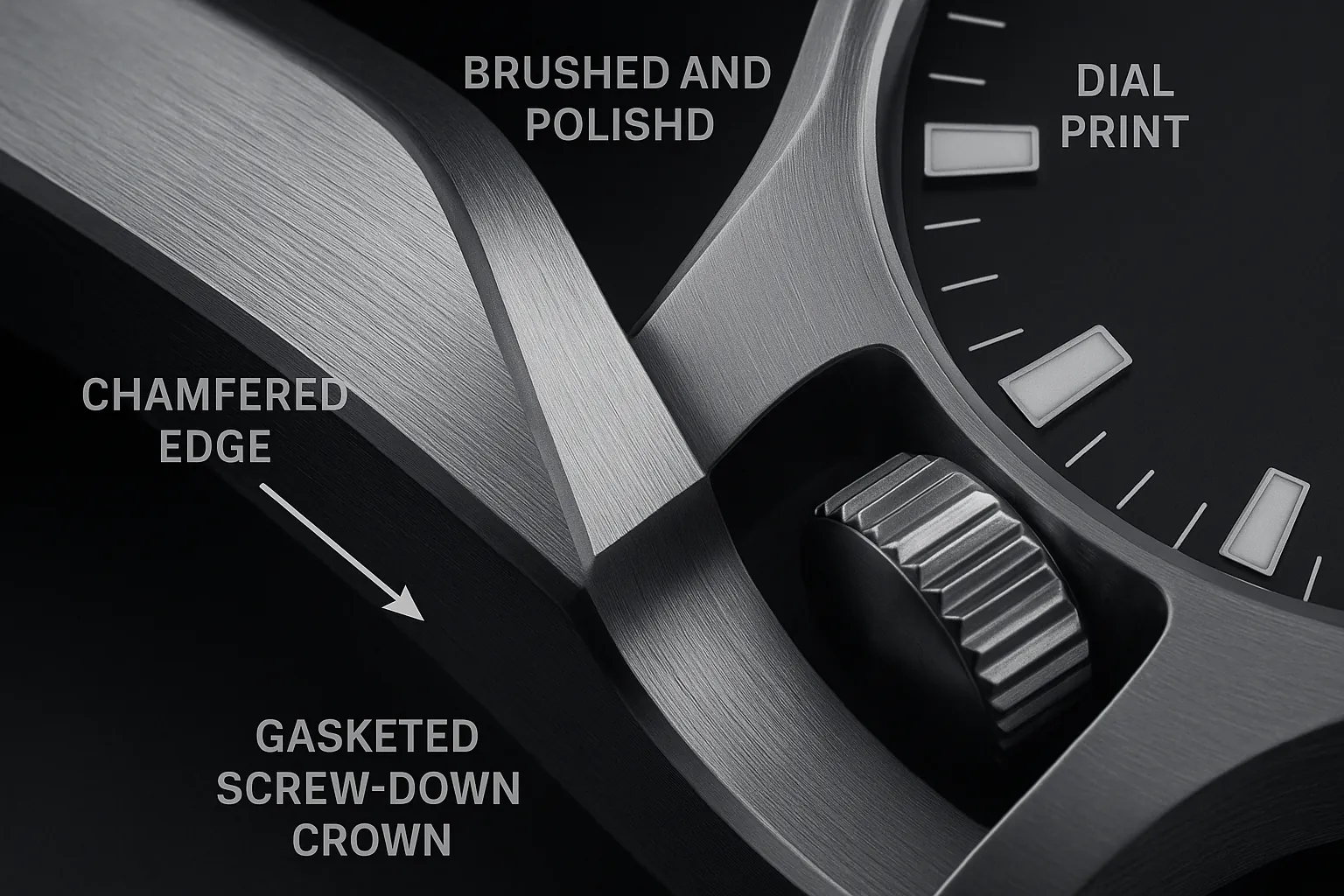
Edge transitions should guide the eye, not cut it. Inspect for even brushing from lug to mid-case, clean printing under magnification, and consistent lume tone across hour markers.
Gasketed casebacks and screw-down crowns form a quiet foundation of trust—engineering precision that keeps moisture and dust away while maintaining long-term reliability.
These meticulous details embody process discipline and translate directly into everyday assurance and tactile confidence.
How to Choose by Wrist, Lifestyle, and Design Language
Start with ergonomics, then aesthetics. A practical wrist map:
| Wrist circumference | Suggested diameter | Perceived feel |
|---|---|---|
| 15 cm / 5.9 in | ≤ 40 mm | Balanced, discreet |
| 17 cm / 6.7 in | ≈ 42 mm | Instrumental yet refined |
| 19 cm / 7.5 in | ≈ 44 mm | Assertive presence |
Thickness and bracelet taper influence sleeve clearance more than diameter alone. Curved lugs and linked bracelets make motion organic. From a market view, analog watches still command ~91% revenue share for timeless design and mechanical feel, according to Grand View Research (Watches Market Size, Share & Trends Report 2033) —your choice aligns with a broader return to tactility.
Buying Guide — 4×4 Experience Matrix
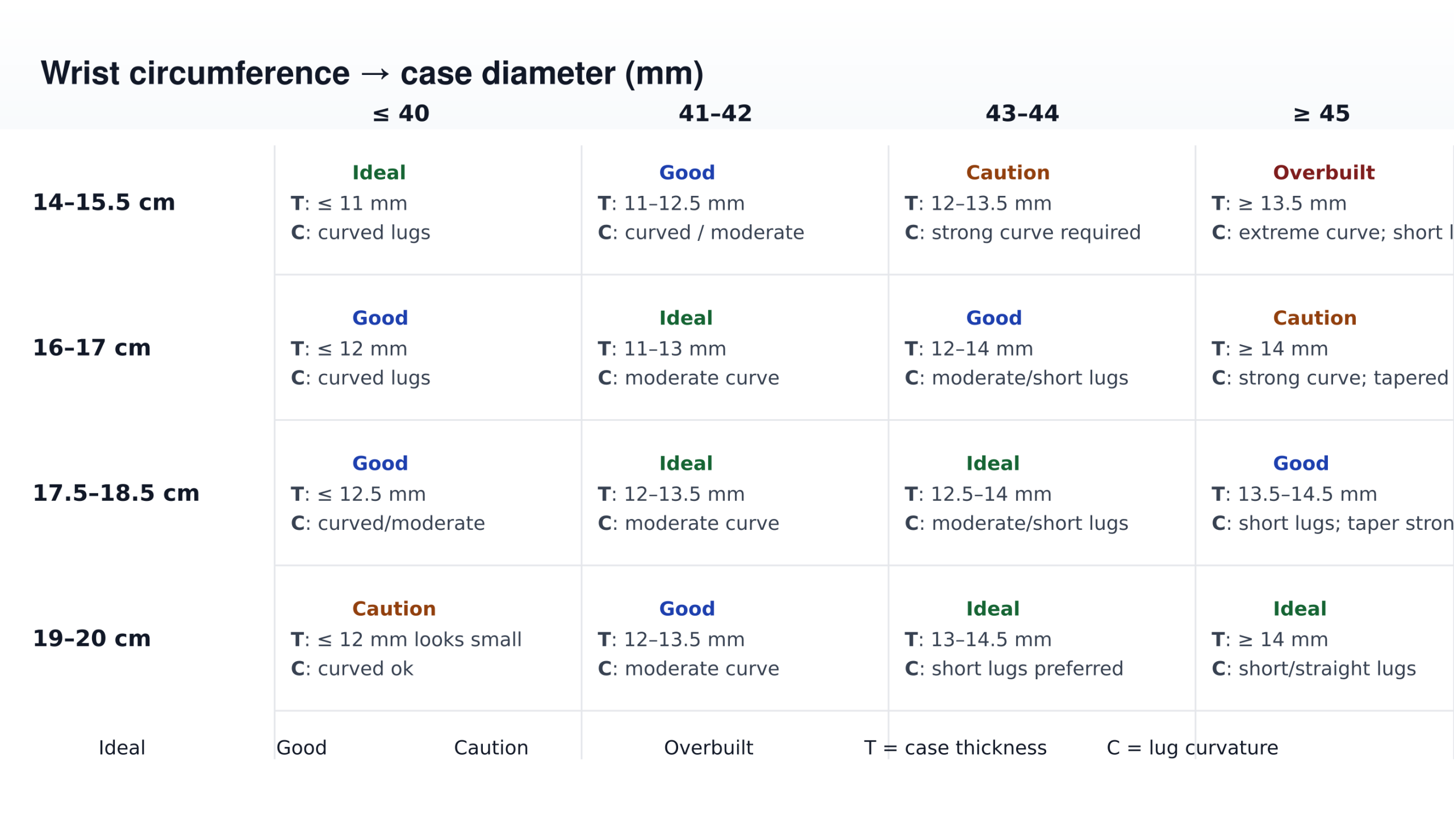
Match wrist size to case diameter. Each cell provides guidance on thickness (T) and lug curvature (C) for balanced comfort and proportion.
Common Mismatches to Avoid—Fit, Weight Balance, and Glare
-
- Sleeve clearance. When thickness > ~13 mm, cuffs can snag. Choose tapered bracelets to visually slim the side profile.
- Bracelet pinch. Limited articulation traps hair; look for tighter tolerances at end links and a clasp with gradual micro-steps.
- AR expectations. Single-side coatings may ghost under office LEDs. If you type under bright lights, prefer double-sided AR.
Fit & Glare Mismatch Scenarios (Practical Reference)
| Issue | Threshold / Observation | Recommended Solution |
|---|---|---|
| Sleeve Clearance | Case thickness > 13 mm | Curved lugs or tapered bracelet |
| Bracelet Pinch | Side-play > 0.3 mm | Micro-adjust clasp (≤ 2 mm increments) |
| AR Reflection | Single-side coating | Double-sided AR or matte dial |
Dial Typography, Bezel Knurling, and Aviation Heritage Cues
Instrument DNA shows up in three places: numerals, knurling, and proportion. Sans-serif numerals with open apertures read instantly; gear-style bezel teeth provide wet-grip confidence; and sub-dial symmetry avoids visual drag. Under mixed light, sapphire + matte dials control reflections so the eye lands on time, not glare. As a design philosophy: homage copies appearance—serious replica work recreates method.
Design Cues — Typography, Gear Texture & Coating
The Breitling replica line emphasizes legibility, confident grip, and restrained finishes. Below is a lightweight, image-free presentation.
Typography — Aperture Ratio
- “8” aperture: 48% (open shapes read faster at a glance)
- “6/9” aperture: 42%
- “0” aperture: 35%
Bezel Knurling — Micro-Teeth Density
- Pilot: about 50 teeth per turn — balanced grip and clear detents
- Diver: about 60 teeth per turn — stronger wet-grip, finer steps
- Dress: about 40 teeth per turn — smoother feel, lower visual aggression
Coating Palette — Neutral Tool Tones (Lab values)
| Tone name | Suggested use | Approx. Lab values |
|---|---|---|
| Deep Navy | Bezels | L*30 a*5 b*-20 |
| Graphite | Dials | L*45 a*0 b*0 |
| Steel Grey | Indices / markers | L*65 a*0 b*5 |
| Midnight | Tool accents | L*15 a*0 b*-10 |
Takeaway: open numerals improve quick reading; consistent knurling supports repeatable torque; neutral coatings control glare and keep a professional look.
FAQ—Wear, Accuracy, and Maintenance
Q: What accuracy window is realistic for automatic pieces?
A: Daily deviation around ±15 s/day is typical; tighter regulation can approach ±8 s/day. Chronometer-grade limits (−4/+6 s) are verified by COSC, which certified ~2.5 million movements with a 3.6% failure rate in its latest report—evidence of rigorous Swiss standards.
Source: COSC — Rapport Annuel 2023 (Official PDF).
Q: How about day-to-day durability?
A: Expect 50–100 m practical water resistance with screw-down crowns and gasket stacks.
Q: Which wrists fit large pilot pieces (41–44 mm)?
A: Comfort depends on lug curvature and strap articulation as much as diameter; curved lugs and linked bracelets make motion feel organic.
Q: How do replica chronographs handle temperature and pressure changes?
A: In-house endurance tests simulate typical dive-watch standards through repeated thermal shock cycles (40 °C → 5 °C → 40 °C) and sustained over-pressure at 125 % of rated depth. These trials verify gasket integrity, torque stability, and overall case sealing without external certification references.
Bring It Together—A Confident Shortlist for Breitling Replica Lovers
Choose by comfort first, then by character. The strongest everyday impressions come from edges that guide the eye, bracelets that move like fabric, and pushers that click with intention. Feel the crown’s thread, the bracelet’s grain, the click between seconds. From there, refine by design language—pilot clarity, dive readiness, or urbane restraint.
As a final thought: modern artisans build with admiration, not imitation—they preserve process and proportion with pride. That’s why many enthusiasts now prize Breitling replica chronograph watches for their wearing experience as much as their looks. For broader category context and brand background, see Luxury replica watches and about page.
The message is simple: enjoy the instrument. Breitling replica belongs on the wrist, not in a glass box.
Disclaimer: This page is an independent style and craftsmanship overview. “Breitling” and all related marks are trademarks of their respective owners. The replica models referenced are independently produced and not affiliated with or endorsed by Breitling SA.
*Last editorial update: November 2025 — verified for accuracy, material composition, and technical references.*